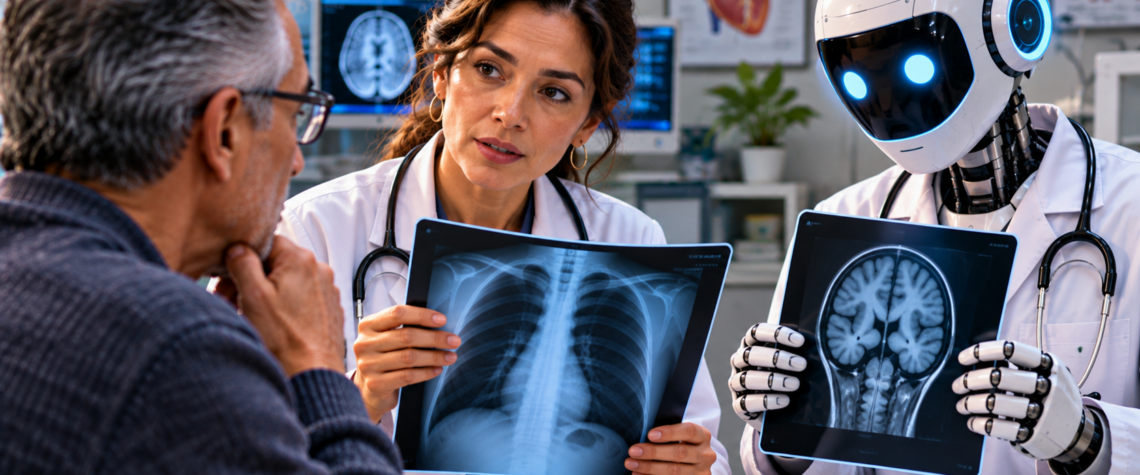
Artificial intelligence is already detecting diseases, interpreting medical tests, and answering patients’ questions. Some systems perform remarkably well in clinical studies. But being able to identify an illness is not the same as being responsible for someone’s health.
A woman wakes up in the middle of the night with an unfamiliar pain in her abdomen. Her doctor’s office is closed, the nearest emergency room is expensive, and she is uncertain whether her symptoms are serious.
She reaches for her phone. Within seconds, an artificial intelligence assistant asks about the location of the pain, how long it has lasted, and whether she has other symptoms. It offers several possible explanations and suggests what she might do next.
The exchange resembles a medical consultation. The assistant is patient, articulate, and available at three in the morning.
But there is one fundamental difference: the system cannot examine her abdomen, measure her vital signs, or reliably determine whether she needs emergency surgery. And if its advice is wrong, the consequences may be serious.
This is the central paradox of artificial intelligence in medicine. AI is becoming increasingly capable of performing tasks once reserved for highly trained professionals. Yet the more convincing its answers become, the easier it may be for patients to mistake technological sophistication for medical judgment.
The question is no longer whether AI will participate in healthcare. It already does. The more difficult question is how much responsibility we should allow it to assume.
When a Machine Outperforms a Doctor
One of the most revealing studies of AI’s medical capabilities was published in JAMA Network Open in October 2024.
Researchers recruited 50 physicians and asked them to solve clinical diagnostic problems. Some doctors had access to GPT-4, while others used conventional diagnostic resources.
Surprisingly, physicians who used GPT-4 did not perform significantly better than those without it.
But when the researchers evaluated GPT-4 independently, the AI system scored substantially higher than the physicians using conventional resources.
The results suggested that advanced language models could demonstrate impressive diagnostic reasoning under controlled conditions.
They also exposed an unexpected problem: giving doctors access to powerful AI does not automatically make them better diagnosticians.
Physicians must know when to trust an algorithm, when to question it, and how to integrate its suggestions with their own clinical judgment.
The study did not establish that GPT-4 could safely replace doctors in actual clinical practice. It involved written cases, not direct responsibility for patients whose conditions might change unpredictably.
Nevertheless, it challenged the assumption that human physicians will always outperform machines at every intellectual component of medicine.
The Difference Between Passing a Test and Treating a Patient
Another study, published in Nature Medicine in 2026, revealed why impressive AI performance does not necessarily translate into reliable medical care.
Researchers evaluated whether members of the public could use large language models to identify medical conditions and decide what level of care was appropriate.
The study involved 1,298 participants and ten medical scenarios. When tested independently, the AI systems correctly identified the underlying conditions in approximately 95% of cases.
But when ordinary people interacted with those same systems, their ability to identify the correct conditions fell dramatically.
Participants using AI identified the relevant condition in fewer than 34.5% of cases, with no advantage over the control group. Their decisions about what medical attention was needed were also frequently incorrect. The lesson was striking.
An AI model can possess information that a patient fails to obtain or interpret correctly during a conversation.
Patients may describe symptoms incompletely, misunderstand follow-up questions, omit important medical history, or place too much confidence in an apparently reassuring answer. Medical care is not simply a question of retrieving the right information.
It also depends on asking the right questions, recognizing what remains unknown, and deciding what to do when the available evidence is incomplete.
AI Is Already Working in Hospitals
While consumer chatbots attract public attention, more specialized forms of artificial intelligence have been entering hospitals and medical practices for years.
According to the U.S. Food and Drug Administration, more than 1,600 AI-enabled medical devices had received marketing authorization in the United States as of September 2026.
These technologies include systems used in medical imaging, cardiovascular care, neurology, and other specialties.
Some analyze scans to identify suspicious abnormalities. Others assist with measurements, highlight potentially urgent findings, or help clinicians interpret physiological signals.
Radiology has become one of the most active areas of medical AI development because imaging produces large quantities of digital information that algorithms can analyze.
But authorization for a specific medical device is not the same as approval for an unrestricted AI doctor.
A system cleared to assist with a particular imaging task cannot automatically be trusted to diagnose unrelated diseases, prescribe medications, or manage a patient’s overall health.
The distinction between specialized medical AI and a general-purpose chatbot is essential.
A consumer assistant that can explain a laboratory result is not necessarily a clinically validated diagnostic device.
The Doctor Knows More Than the Symptoms
Consider two patients who report the same complaint: persistent fatigue.
One may be experiencing stress and insufficient sleep. Another may have anemia, thyroid disease, depression, medication side effects, or an undiagnosed chronic illness.
The words used to describe their symptoms may be nearly identical. But their medical histories, physical examinations, medications, and laboratory findings could point toward entirely different explanations.
An experienced physician considers information that patients may not recognize as relevant. A doctor may notice changes in breathing, unusual skin color, swelling, confusion, or subtle signs of neurological impairment.
Physical examination can reveal information that a text conversation cannot supply. AI may help analyze this information when it is available, but a chatbot cannot assume that missing information is normal. Nor should it confidently exclude serious illnesses simply because a patient did not mention a particular symptom. That uncertainty is especially important when an illness develops over time.
A physician can order additional tests, reassess an evolving condition, coordinate treatment with specialists, and adjust a plan as new evidence emerges. A chatbot can help explain these processes. It cannot automatically provide the full clinical infrastructure behind them.
What Happens When AI Makes a Mistake?
Doctors make mistakes, and medicine has developed professional standards, licensing requirements, institutional oversight, and legal mechanisms intended to reduce errors and address harm.
Artificial intelligence introduces new questions about accountability. If a hospital uses an AI system that fails to identify a dangerous condition, who is responsible? The physician who relied on its recommendation? The hospital that purchased the system? The company that developed it?
The answer depends on the circumstances, the technology’s intended use, and applicable law. For consumer chatbots, the situation may be even more complicated. A patient might act on an AI-generated recommendation without ever consulting a licensed clinician.
The system may provide a persuasive explanation without clearly communicating how uncertain the answer is. The World Health Organization has warned that generative AI can produce inaccurate, incomplete, or biased medical information. It has also identified automation bias: the tendency of people to accept a machine’s recommendations while overlooking errors they might otherwise recognize.
This creates a particular danger in medicine, where an answer that sounds reasonable can still be dangerously wrong.
The Human Relationship
A medical consultation is not merely an exchange of information. Patients may arrive frightened, embarrassed, confused, or unwilling to disclose something important.
A physician must sometimes recognize what a patient is avoiding, explain a difficult diagnosis, or help someone choose between treatments with different risks and consequences. An AI assistant can produce language that sounds compassionate. It can explain treatment options patiently and without visible frustration. For some people, that may make it easier to ask sensitive questions. But generating a compassionate response is not equivalent to assuming the professional and ethical responsibilities of caring for a patient.
A physician must consider the patient’s circumstances, preferences, family responsibilities, and capacity to follow a treatment plan. There are also situations in which the correct medical decision is not simply the one most likely to produce a favorable statistical outcome. Patients may reasonably choose different treatments because they value independence, comfort, longevity, or quality of life differently.
Medicine involves scientific knowledge, but it also involves judgment, trust, and shared decision-making. Those responsibilities cannot be reduced to predicting the next sentence in a conversation.
Could AI Make Healthcare More Accessible?
One of the strongest arguments for medical AI concerns access. Millions of people face long waits for appointments, difficulty finding specialists, transportation barriers, or healthcare costs they cannot comfortably afford.
An AI assistant available at any hour could help patients understand medical terminology, prepare questions, organize symptoms, or recognize when professional evaluation may be necessary.
For people living in areas with limited medical services, such tools could become valuable sources of preliminary information.
AI may also reduce the administrative work that consumes physicians’ time.
Systems that help prepare clinical notes, summarize records, or organize information could allow doctors to devote more attention to patients.
The American Medical Association reported in 2026 that more than 80% of physicians surveyed were using AI in their professional work, although that figure covers many different applications, not just diagnosis.
The opportunity is substantial. But there is a risk that deserves scrutiny.
If inexpensive AI services become the default source of advice for patients who cannot afford physicians, while wealthier patients continue receiving comprehensive human care, technology could reinforce rather than reduce healthcare inequality.
The goal should be to expand access to reliable care, not create a lower standard of medical attention for people with fewer resources.
Why Doctors Are Calling It Augmented Intelligence
The American Medical Association deliberately uses the expression augmented intelligence to emphasize technology that enhances human clinical judgment rather than replacing it.
In September 2026, several leading U.S. medical organizations issued a joint statement defending the importance of physician expertise and patient safety while recognizing AI’s potential.
Their position reflects a broader debate over how medical AI should be introduced.
Doctors should not dismiss useful technology simply because it challenges established practices.
But hospitals and technology companies should not treat impressive laboratory results as sufficient evidence that an algorithm can safely assume responsibility for patients.
The future may involve a redistribution of medical tasks. AI could handle more routine documentation, identify patterns in medical data, support screening, and help clinicians evaluate possible diagnoses.
Physicians could devote more time to complex cases, physical examinations, treatment decisions, and direct communication.
Whether that future improves healthcare will depend on how the systems are evaluated, regulated, and integrated into clinical practice.
How Patients Can Use AI Without Putting Their Health at Risk
For consumers, the safest approach is to treat a general-purpose AI assistant as an information resource rather than a replacement for medical care.
AI can be useful for understanding unfamiliar terms in a laboratory report, preparing questions for an appointment, learning about a diagnosed condition, or organizing a list of symptoms and medications to discuss with a clinician.
It can also help patients understand why a physician might recommend a particular test or treatment. But important precautions remain.
Do not use a chatbot’s answer as a definitive diagnosis. Several illnesses can produce similar symptoms, and serious conditions sometimes begin with seemingly minor complaints.
Do not start, stop, or change prescribed medication solely because AI recommends it. Drug interactions, allergies, kidney or liver function, and other factors can substantially change treatment decisions.
Verify medical information through qualified professionals and reliable sources. An AI-generated explanation can contain errors even when it sounds authoritative.
Protect your personal information. Avoid submitting unnecessary identifying details or confidential medical records to services whose privacy practices you do not understand.
Seek urgent medical attention for warning signs. Symptoms such as chest pain, severe difficulty breathing, sudden weakness on one side of the body, or other signs of a medical emergency require immediate professional evaluation—not a prolonged chatbot conversation.
Above all, use AI to become a better-informed participant in your healthcare, not to remove qualified medical judgment from the process.
The Doctor of Tomorrow
Artificial intelligence is already changing medicine, and its capabilities will continue to evolve.
It may become better than physicians at particular tasks. It may detect patterns that human observers overlook. It may help identify diseases earlier and make sophisticated medical information accessible to people who previously struggled to obtain it.
But the ability to solve diagnostic problems is only one part of being a doctor.
A physician must interpret uncertain evidence, examine the patient, coordinate treatment, respond to complications, and remain accountable for professional decisions.
The central question, therefore, may not be whether AI can replace the doctor.
It may be whether healthcare systems can use increasingly powerful machines without losing the human responsibility that makes medical care more than an exchange of information.
For patients, the most promising future is not necessarily a choice between a human doctor and an artificial one.
It is a future in which the technology makes medical expertise more accessible, more accurate, and more responsive—while ensuring that someone remains responsible for the person receiving care.
Sources and Further Reading
- Goh et al., Large Language Model Influence on Diagnostic Reasoning: A Randomized Clinical Trial, JAMA Network Open, October 2024.
- Reliability of LLMs as Medical Assistants for the General Public: A Randomized Preregistered Study, Nature Medicine, 2026.
- U.S. Food and Drug Administration, Artificial Intelligence-Enabled Medical Devices, September 2026.
- World Health Organization, Ethics and Governance of Artificial Intelligence for Health: Guidance on Large Multi-Modal Models, 2024.
- American Medical Association, Augmented Intelligence in Medicine, updated July 2026.
- American Academy of Family Physicians, American Academy of Pediatrics, American College of Obstetricians and Gynecologists, American College of Physicians, American College of Surgeons, and American Medical Association, joint statement on augmented intelligence in healthcare, September 2026.